Step 1: The charter request
It all starts with the charter request. This can be sent to us through various channels: via the charter form on the website, by phone, by email or through a broker. To enable us, as the operator, to thoroughly assess the flight, the following information is required at this stage:
Flight date and desired departure time or, alternatively, a flexible travel period within which we can provide the best possible offer
Departure and destination airports or a rough destination so that the nearest airport suitable for the respective aircraft category can be identified
Number of passengers
Luggage and any special requirements
The earlier and more precise this information is provided, the greater the operational flexibility in further planning.
Step 2: Internal assessment of feasibility and safety
Upon receipt of the request, we conduct an internal assessment to determine whether the flight can be carried out safely and in compliance with regulations. This includes checking aircraft availability, crew availability, potential airport restrictions and regulatory requirements. Not every request can be automatically fulfilled—safety and regulations always take priority for us.
Step 3: Selection of the appropriate aircraft from our own fleet
If the flight can be carried out as planned, the appropriate aircraft is selected. Two levels of selection criteria interact here: the customer's requirements for the flight and our binding specifications.
Selection criteria based on the customer's requirements:
Mission profile (e.g., route, flight time, direct flight or stopover)
Cabin configuration (space, comfort, number of seats)
Range and payload
Additional requirements:
We only use aircraft from our own fleet or via subcharter, i.e., aircraft that we lease and provide for the mission. Only subcharter operators audited by us and meeting our defined standards are approved—particularly with regard to safety, crew training, and operational quality. This ensures that uniform safety and maintenance standards are adhered to and that trusted, qualified crews are deployed.
Step 4: Charter offer and pricing structure
In the next step, the charter offer is prepared. The pricing structure depends on the flight and time, as each charter flight is calculated individually. The basis is the flight time, i.e., the actual time flown from departure to landing. This forms the basis for most cost components.
Several variable cost factors are also included in the calculation:
Fuel cost (depending on distance, altitude and market conditions)
Crew cost (duty times, route profile)
Handling and landing fees at departure and destination airports
Geopolitical situation
As these factors can vary significantly depending on the flight, there are no flat rates in the charter sector. Each calculation is tailored precisely to the specific flight.
Step 5: Contract conclusion and payment
Once the booking has been made, a key step follows: the conclusion of the contract between us and the charter customer. In general, the charter contract is concluded directly with the charter customer. In many cases, however, the order is placed through a broker, i.e., an intermediary who acts between us and the end customer. In this case, the contract is concluded between us and the broker, who in turn has a separate contractual relationship with the end customer and is responsible for customer communication and coordination.
As a rule, advance payment is required before the flight.
Step 6: Operational preparation
Once the contract is signed, we begin the operational preparation of the charter flight. This includes the following measures in particular:
Slots and permits: The necessary takeoff, landing and overflight permits are obtained.
Coordination with FBOs and handling agents: Coordination with ground handlers and FBOs ensures smooth operations on the ground—from the arrival of passengers to departure.
Catering and special requests: Individual services and special requests from passengers are organized to ensure not only safety but also a high level of comfort on board.
Crew briefing: The crew is provided with comprehensive information about the route, flight profile, special features of the mission and customer-specific requirements. This ensures that everyone involved is optimally prepared.
Flight planning and weather analysis: Detailed route planning, including fuel calculations and ongoing analysis of weather conditions are carried out in order to take any potential risks or restrictions into account at an early stage.
Step 7: The day of departure
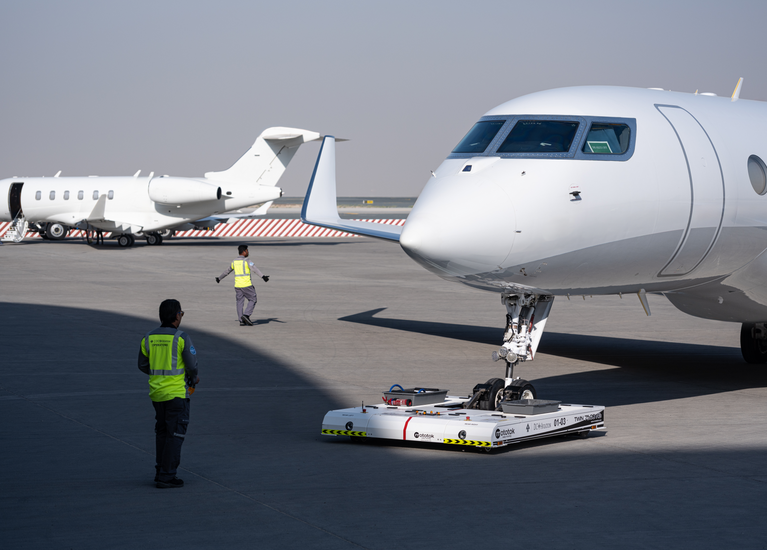
On the day of departure, the crew arrives early and the aircraft is technically approved so that all procedures are optimally prepared. The aircraft is towed, carefully prepared and refueled. At the same time, the individually ordered catering is brought on board and prepared for the flight. Passengers typically arrive 15 to 30 minutes before departure, are greeted personally by us and handed over directly to the crew. In the event of a delay, plans are flexibly adjusted and the airway slot is optimized accordingly to keep waiting times to a minimum. This allows takeoff to proceed without long delays.
Step 8: Arrival and post-flight care
Our responsibility does not end after landing. We coordinate the processes at the destination airport in close consultation with the handling agents, organize transfers for passengers on request and remain flexible for connecting flights or last-minute changes. This continuous support ensures that the journey continues smoothly after the flight and underscores the commitment to a professionally managed charter operation.
Conclusion: Why charter is more than just a flight
Charter is more than a technical process: it is about fulfilling individual travel wishes, making special moments possible and enabling flexible mobility.
DC Aviation Group sees itself as a long-term partner and supports customers with personal advice and comprehensive experience, from the initial inquiry to well beyond the flight.